
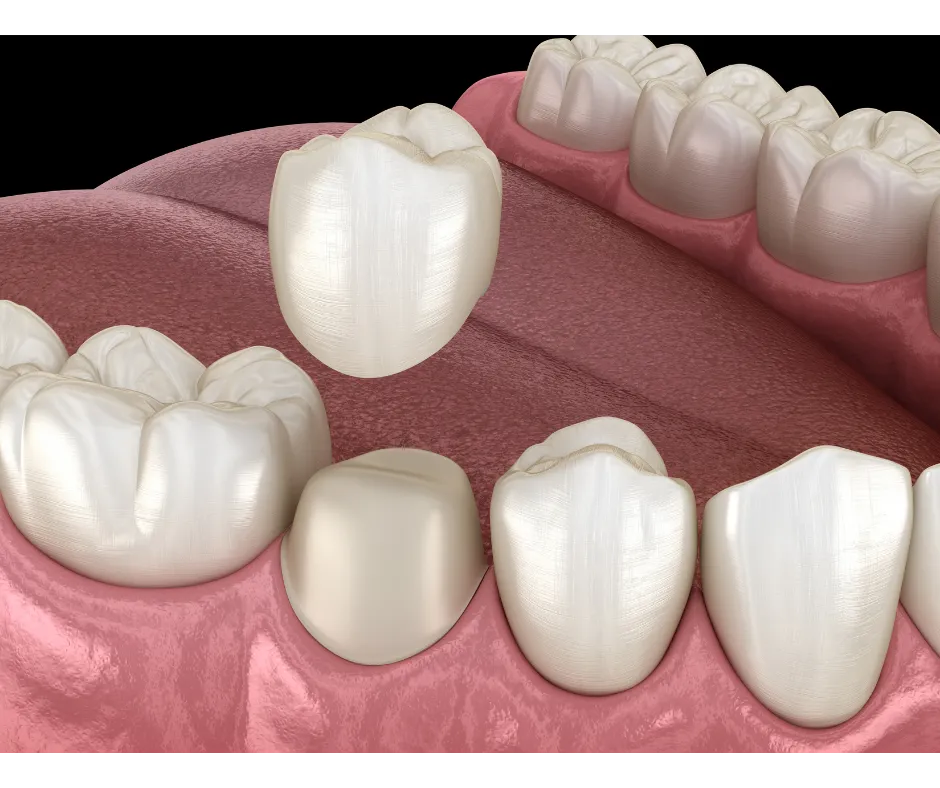
Fillings repair, crowns rebuild
A filling fills a hole. A crown covers and rebuilds the entire chewing surface of the tooth. The decision between them isn't a preference, it's a structural call. When too much of the original tooth is gone, a filling no longer has enough surrounding tooth to bond to safely. Trying to use one anyway risks the remaining tooth cracking under chewing forces, which usually means a root canal or extraction down the line.
When a filling is the right call
A standard tooth-colored filling works when:
- The cavity is small to medium (less than one-third of the tooth)
- The walls of the tooth around the cavity are still intact
- There are no existing cracks or fractures
- The tooth isn't already heavily restored from previous fillings
When a crown is the right call
A crown is recommended when:
- More than half the tooth structure is missing or compromised
- There's a visible crack or fracture extending into the tooth
- The tooth has had a root canal (root-canaled teeth become brittle)
- A previous large filling has failed or fractured
- The patient has a heavy bite or active grinding habit
The in-between option: onlays
Sometimes a tooth falls between filling and crown territory. In those cases, we may recommend an onlay (sometimes called a partial crown). An onlay covers one or more cusps of the tooth but preserves more healthy structure than a full crown. It's typically made of porcelain or zirconia, bonded into place, and lasts as long as a crown.
What it costs to wait
Putting off a recommended crown is one of the most expensive decisions you can make. A cracked tooth that needs a crown today often needs a root canal in 6-12 months if untreated, and an extraction plus implant in 1-3 years. Catching the right restoration at the right moment usually saves both the tooth and several thousand dollars in downstream care.
How we'll explain your options
At your exam, we'll show you the tooth on our intraoral camera or X-ray, walk you through what we're seeing, and give you a written estimate for each option. No pressure, no surprises.
What happens if you wait too long for a crown
When a tooth needs a crown and gets another large filling instead, the most common outcome is a fracture, sometimes mild (a chipped cusp we can rebuild), sometimes catastrophic (a split that requires extraction). The walls of a heavily-filled tooth flex slightly under chewing force; a crown distributes the pressure across the whole tooth.
The other risk is nerve damage. A tooth that's been drilled out repeatedly may develop pulpitis (nerve inflammation), which can progress to needing a root canal, turning what would've been a single crown appointment into a two-stage root canal + crown treatment. When we recommend a crown, the timing matters as much as the procedure itself.
Questions about your specific case?
Every patient's mouth is different. The article above covers the general principles, for a personalized recommendation, schedule a consultation with Dr. Sidhu.